
Principles · Our philosophy
Life is tended, not completed.
Pamplemousse begins with a simple belief: life is easier to steer when you can see what you have chosen or need to keep tending. Not as one endless task list, but as a living set of commitments, relationships, projects, routines, and next actions.
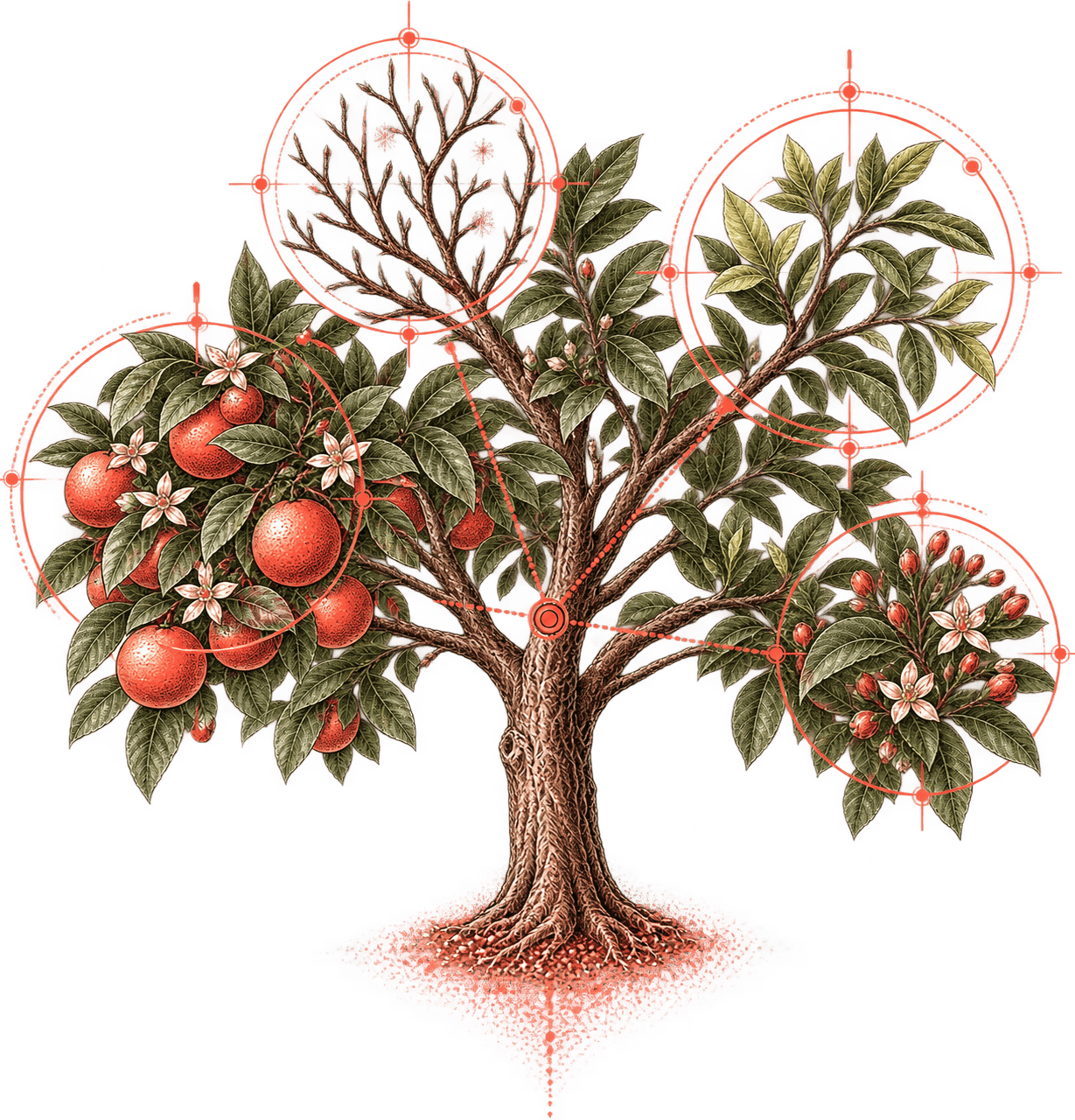
See the whole, not only the urgent
The loudest thing today is not always the most important thing in your life.
Pamplemousse is built around a commitment inventory: a reviewable picture of the areas, roles, responsibilities, relationships, aspirations, and obligations that currently ask something of you. Health belongs there. So do finances, home, learning, creative work, community, and rest.
Bringing those commitments into view does not make every part of life a project. It makes neglected areas easier to notice and tradeoffs easier to make deliberately.
Visibility before optimization.A clear view of your commitments is more useful than another system for moving faster without asking where you are going.
Give every commitment the right shape
A life area is not a project. A project is not a next action. A relationship is not a task with a due date.
Pamplemousse gives each kind of commitment an appropriate place:
- Groves hold enduring areas of life or work.
- Roots preserve why those areas matter.
- Grapefruits hold projects and outcomes.
- Segments divide larger projects into useful phases.
- Seeds are concrete actions; Sprouts are their smaller steps.
- Branches preserve relationship context.
- Pulp holds notes and supporting material.
- Harvest keeps completed work available for reflection.
The vocabulary is distinctive, but the purpose is practical: make the structure understandable without turning life into bureaucracy.
Model meaning, not merely motion.Good organization should preserve the difference between what you care for, what you want to change, and what you can do next.
Keep work and life connected, not collapsed
Work and Life can share one place without becoming one pile.
Pamplemousse uses separate modes so professional commitments do not crowd out personal ones, and personal context does not need to appear in every work view. The same interface can support both, while each mode keeps its own focus, reporting, and suggestions.
That separation is an organizational boundary, not a claim that work and personal data use different infrastructure or security domains.
Connection without collapse.Your life has relationships between its parts. It should not require every part to compete on the same screen.
Support a method; do not enforce an ideology
Pamplemousse recommends a commitment inventory, but it does not define a correct life or a single correct way to organize one.
Its structure can work alongside approaches such as Getting Things Done, PARA, the Eisenhower Matrix, or Eat the Frog. Rename a Grove. Ignore a suggested category. Keep the parts that help and leave the rest.
A trusted system should adapt to the person using it, not ask the person to perform for the system.
Structure should remain negotiable.The product can offer a point of view without turning that point of view into a rule.
Let technology return attention
Software should help you decide, then get out of the way.
Pamplemousse is designed to make commitments visible, preserve their context, and surface a manageable next move. Zest, its optional AI-supported decision layer, is requested by the user rather than continuously generating commentary. When AI processing is unavailable or not permitted, the product can return locally ranked, deterministic cards instead.
The aim is not an app that talks more. It is an app that helps you see more clearly.
Assistance should be bounded.A useful assistant works from evidence, shows restraint, and leaves judgment with the person.
Tend what matters, with the whole grove in view.
Pamplemousse is currently in private beta. Access is available by invitation.